

Virtual Program
Creating a program of repertoire from both Black and White repertoires presents great challenges. Because of terrible social inequities and injustices, early written musical sources of Black songs, prior to the choir arrangements of the late nineteenth century, are far too few. We’ll be there! draws on the precious few songbooks as well as the collaborative memory and ongoing oral tradition of musical knowledge in the Black community. Within the songbooks, the mutual influences of both white and Black communities are omnipresent. Take a look at excerpts from some of the songbook sources below:
“Revival Hymns and Plantation Melodies”
“Revival Hymns and Plantation Melodies” (Cincinnati, 1882) is an important source of Black repertoire collected by Marshall W. Taylor (1846–1887), several works on the program are drawn from this collection including “Let us Cheer the Weary Traveler.”

“Revival Hymns and Plantation Melodies” title page.

Portrait of “Revival Hymns and Plantation Melodies” author, Marshall W. Taylor (1846–1887).

“Let us Cheer the Weary Traveler” from “Revival Hymns and Plantation Melodies”
The Sacred Harp
The Sacred Harp is both a song book and an entire singing tradition in itself. First published in 1844, the Sacred Harp is designed to welcome newcomers and help teach and facilitate congregational singing. The book contains an introduction to the fundamentals of music & notation, explaining its unique shape note notation style. This notation style uses four note shapes to help indicate the scale’s corresponding solmization syllables. In this system, “Fa” is a triangle, “Sol” is a round note, “La” is rectangular, and “Mi” is a diamond.

Title page from 1844 edition of The Sacred Harp.

An introduction page from the 1844 edition of The Sacred Harp explains the unique shape note system used with its similarly unique solmization system (Fa-Sol-La-Mi).

The music of “Pisgah” from the Sacred Harp is set to the text, “Alas, and am I born for this?” by poet George M. Horton (b. 1798), known as the "Slave Poet" and “The Colored Bard of North-Carolina”

“Cussetta” from tonight’s program and the 1860 edition of The Sacred Harp.
The Revivalist
In The Revivalist (1868) we note the call-and-response format, ubiquitous in revivalist camp meetings and so typical as well of African-American group singing.

“Roll Call” From The Revivalist (1868).

“Shall We Gather?” From The Revivalist (1868). The audience is invited to sing along in the chorus of this powerful melody.
View some of these songbooks in full:
Revival Hymns and Plantation Melodies
https://archive.org/details/07697169.4831.emory.edu/page/n7/mode/2up
The Revivalist
https://archive.org/details/revivalistcollec00hill/mode/2up
Religious Folk Songs of the Negro
https://archive.org/details/religiousfolkson00fenn/mode/2up
The Social Harp
https://archive.org/details/socialharpcollec0000mccu
The Sacred Harp
1844 https://archive.org/details/sacredharporecle184400maso/mode/2up
1860 https://archive.org/details/11394316.4428.emory.edu/mode/2up
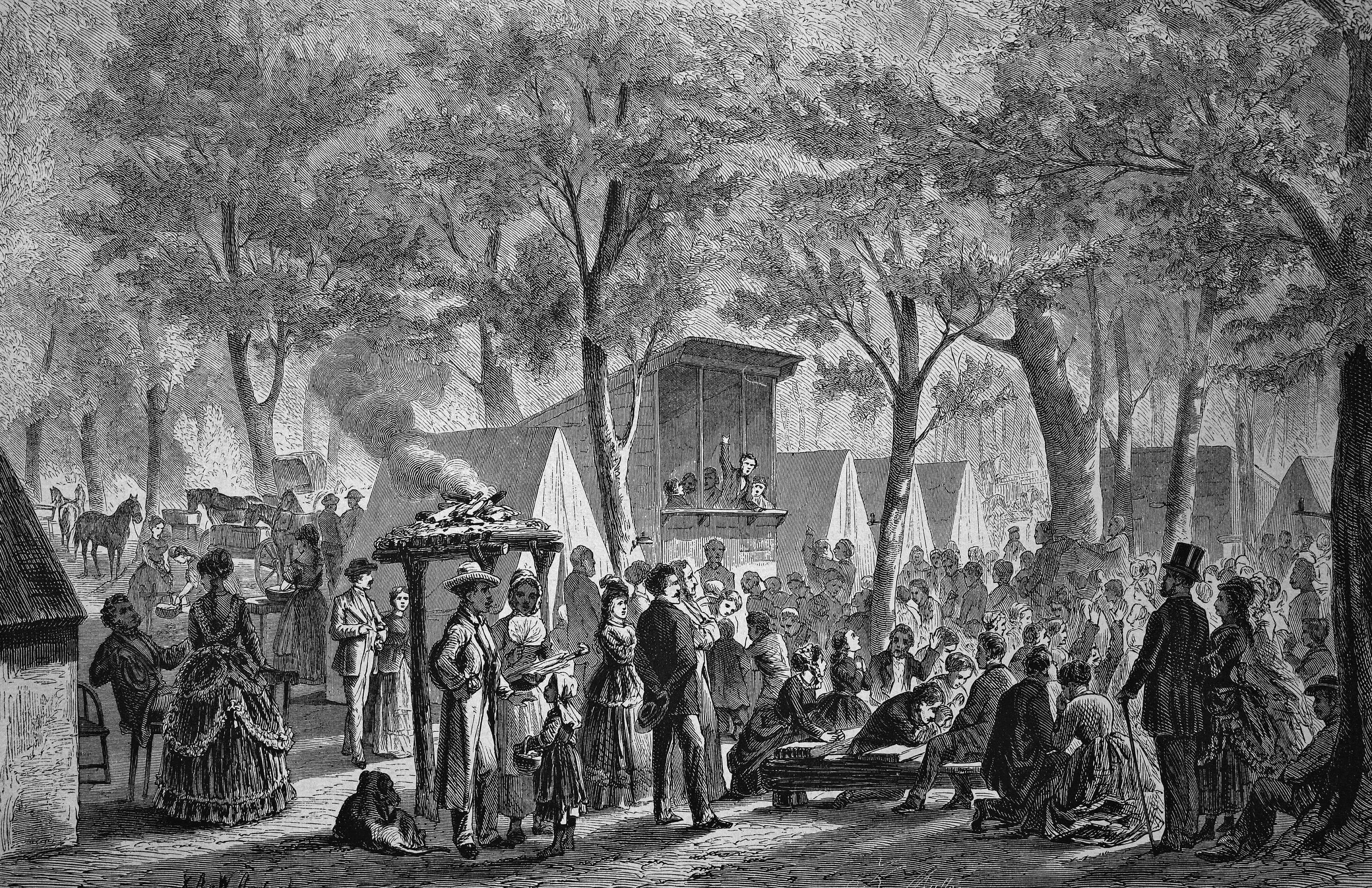
Camp Meetings
Camp meetings were a popular form of Protestant worship throughout the 19th century. Lasting several days, these open-air events often involved ecstatic communal prayer. Hundreds and even thousands came from miles around for preaching and worship, and to enjoy the festival-like atmosphere.
Image courtesy of The Boston Camerata.


In Bocca al Lupo | Feb 8—Mar 2

Step into a world where the familiar is turned upside down, and where the traditional and the modern collide in a mesmerizing musical experience!
Mundus Inversus features a talented ensemble of early music specialists led by multi-instrumentalist Shira Kammen. Drawing inspiration from iconic Medieval sources like the Roman de Fauvel and the Carmina Burana, this unique performance blends timeless melodies with newly-composed pieces that explore the chaos and disarray of our modern times.

Explore the rest of the season!