

VERSAILLES: POWER CENTRALIZED

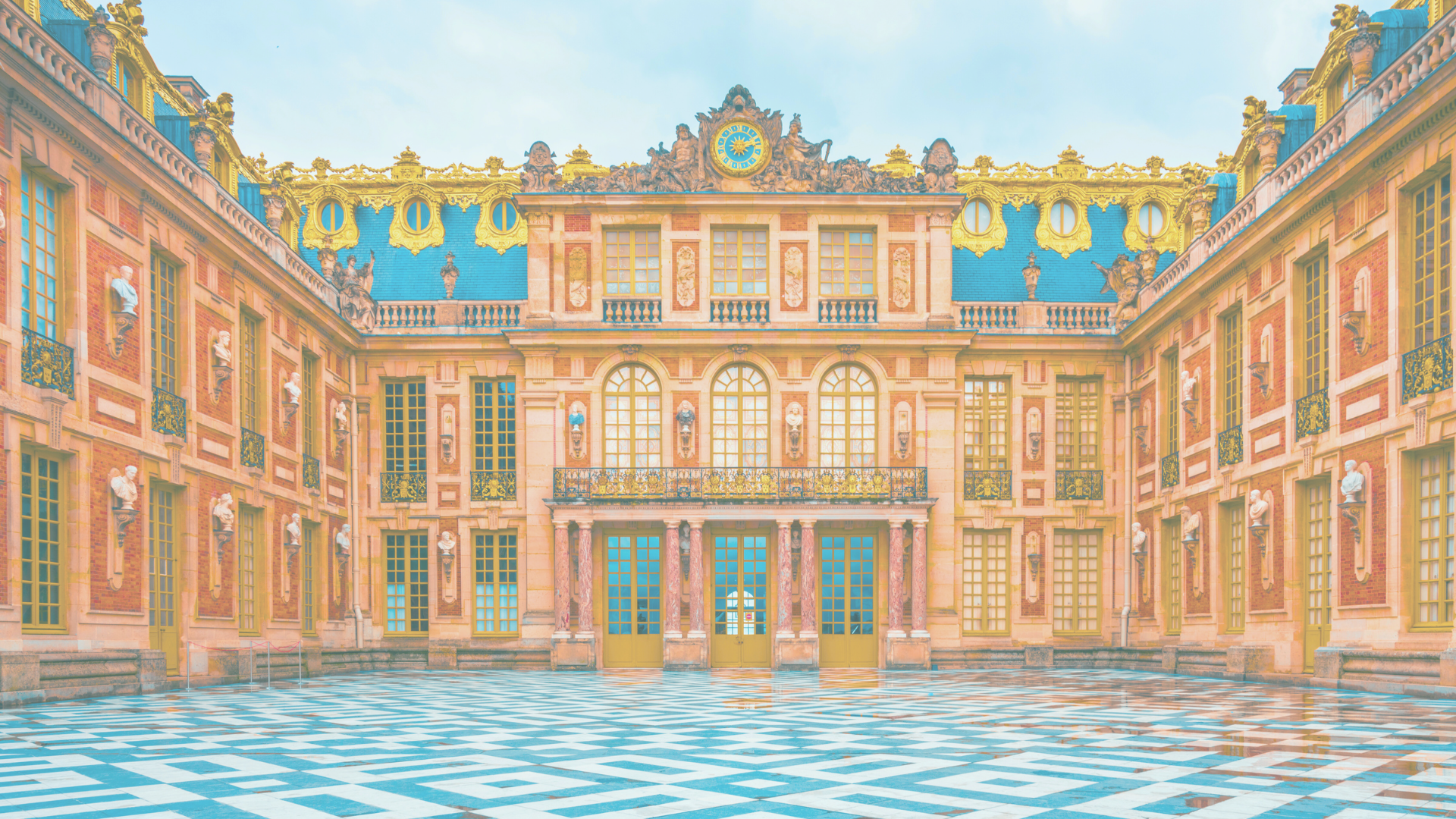
Versailles c. 1668, painted by Pierre Patel
Known as the “Sun King,” Louis XIV (b. 1638, r. 1643–1715) sought to centralize French power within his royal person to a degree unmatched by his predecessors. In “compelling” many in the nobility to move to his new palace at Versailles—a former hunting lodge of his father’s—Louis was able to channel domestic discipline into military might, elevating France into the first rank of European powers. Music became a projection of the opulence and grandeur of Louis’ court.

LOUIS & LULLY
Who was going to be the person to create the royal music that Louis XIV longed for? It came in the unexpected form of Jean-Baptiste Lully, né Giovanni Battista Lulli of Florence. Brought to France when he was 14 as an Italian tutor to the Madame de Montpensier, he came to the attention of the young Louis XIV when they danced together in 1653 in the Ballet Royal de la Nuit. He was soon appointed royal composer for instrumental music, and over the next three decades, he navigated the treacherous waters of court life to deservedly become the “monarch” of French royal music. How did this Italian—vain, tempestuous, yet immensely talented—manage to create what we now immediately recognize as the sound of the French Baroque?

Louis XIV as Apollo (1653)

Lully, ca. 1670
THE “FRENCH BAROQUE” STYLE
By the early 18th century, the French and Italian “national styles” of music had emerged in opposition to each other. Even if the differences were somewhat exaggerated, the French emphasis on (learned) simplicity—a reflection of theatrical practice—meant that French music was first and foremost wedded to textual clarity. Matters of phrasing and rhythm were subordinate to making the words comprehensible, with any ornamentation extremely refined and restrained.
two major national styles: French and Italian

MICHEL LAMBERT
Tonight’s program demonstrates Lully’s gradual mastery of French vocal declamation. He certainly owed a great debt to his father-in-law Michel Lambert (ca. 1610–96), the preeminent and last master of the air de cour, intimate and generally strophic songs long in favor at the French court. Lambert’s exquisite output is represented tonight in four songs.

LULLI TO LULLY

During his tumultuous ascent to the top of French court music in the 1650s and 1660s, the Italian-born Lully aspired to become more French than the French. Composing less and less in his native language, he achieved a breakthrough in 1673 with Cadmus et Hermione, the first of his dramatic operas, or tragedies en musique. Up until the French revolution, the tragedie en musique was considered the pinnacle genre of French music, with Lully’s works often revived in Paris and beyond. These works were a unique blend of Italian instrumental innovation and French textual declamation, marrying spectacle with simplicity. This is amply demonstrated tonight in Io’s lament, “Terminez mes tourments” from his 1677 opera, Isis.
LIFE AFTER LULLY (I): MONTECLAIR

La retour de la paix
Lully’s untimely death in 1687 cast a long shadow over the life of royal French music; for the next century, French composers were almost invariably compared to Lully in terms of substance and style. Nonetheless, major musical voices emerged in the next generation; Michel Pignolet de Montéclair found success in the form of the cantate, a new vocal genre that emerged in cosmopolitan Paris. He drew upon the latest Italian trends (one may sense a pattern here) to compose works such as the pastoral La Bergère and the dramatic Le retour de la paix, a masterful survey of mood and tonality.

basse de violon
LIFE AFTER LULLY (II): COUPERIN

Similarly, François Couperin synthesized various national styles to cement place in French musical history as the grand master of the harpsichord, thus also sidestepping Lully’s influence. Yet his trio sonata on tonight’s program—nicknamed ”Le Steinkerque” in honor of a French military “victory”—reminds one that music was still a vital projection of French cultural ambition, and that the sound of music in Versailles was inevitably mixed with the exercise of absolute power.

L’apothéose de Corelli (1724) — Couperin’s homage to unifying the French and Italian styles


Boston Camerata | Jan 30 & 31
The Boston Camerata continues its trailblazing exploration of the American spiritual tradition. Drawn from early Black and white songbooks, "We'll Be There!" explores the intertwined traditions that have bound our nation together through generations of joy, sorrow, and striving.

Explore the rest of the season!